How to Keep a Private Decision Journal (Without Overthinking It)
A practical how-to for logging consequential decisions privately—before outcomes rewrite your memory—then reviewing them without an audience.
Some decisions deserve a record. Not every choice—just the ones that matter enough that future-you will rewrite the story if you don't write it down first.
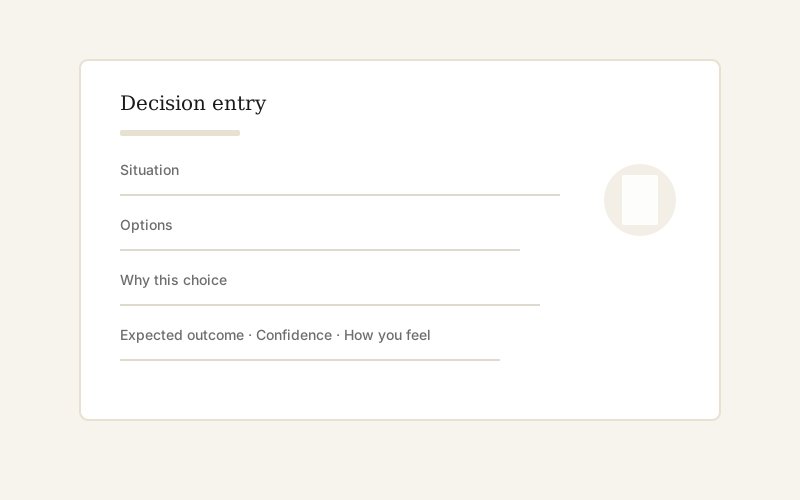
A private decision journal is simple: before (or right as) you decide, you capture the situation, the options, why you're leaning a certain way, what you expect to happen, how confident you feel, and how you feel about it. Later—after the outcome is known—you review the process, not just whether you "got it right."
No audience. No performance. Just an honest trail of how you thought when the answer wasn't obvious yet.
When to use a decision journal
Use it when the choice is consequential enough that hindsight will tempt you to edit the past.
Good candidates:
- A work decision with lasting tradeoffs (hire, ship, pause, say no)
- A money or commitment choice you can't easily undo
- A personal choice where two values pull in different directions
- A "I'm circling this" decision that keeps replaying without moving
Skip it for tiny, reversible choices. What to eat, which playlist, whether to reply now or in an hour—those don't need a template. Eight everyday moments worth capturing includes decision-circling as one doorway into clearer thinking; this post is the how-to for that doorway.
If you're already writing in a private thinking journal, decision entries can live alongside everything else. You don't need a second app—just a short, repeatable shape.
The short template (keep it under ten minutes)
Copy this into an entry. Fill what you can. Leave blanks if you must. Done is better than perfect.
Situation
What's going on, in one or two sentences? Who's affected? What's the real constraint?
Options
List the live options—usually two to four. Include "do nothing / wait" if that's real.
Why (leaning this way)
Why does one option feel right today? Name the reasons, not the branding. Include doubts.
Expected outcome
What do you think will happen if you choose X? Be specific enough that later-you can check it.
Confidence
A plain label is enough: low / medium / high. Or a quick note like "clear on values, fuzzy on timing."
How you feel
Anxious? Relieved? Numb? Excited and scared at once? Feelings are data about stakes and risk—not a verdict.
That's the whole template. You can expand later. You don't need a spreadsheet.
Write before the outcome
This is the rule that makes the practice work.
Write while the decision is still open—or immediately after you choose, before results arrive. Outcomes are loud. They rewrite memory. A good result makes the path look inevitable; a bad one makes every doubt look like a warning you ignored.
If you only journal after the fact, you're writing a story about the decision, not a record of the reasoning. Both can be useful. Only the before-entry protects you from hindsight theater.
Practical tip: if you're mid-decision and short on time, capture Situation + Options + Why in five minutes. Add Expected outcome and Confidence when you commit. Feeling can be one word.
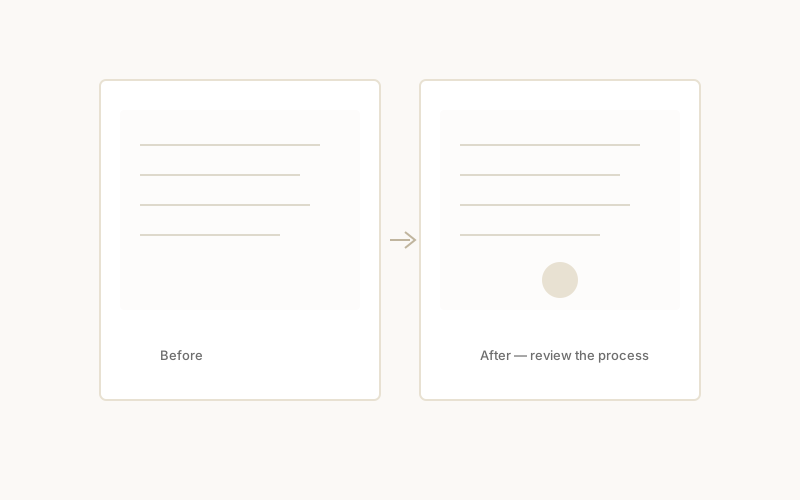
Review later (process, not scoreboard)
Pick a review moment after enough time has passed that the outcome is clear—or clearly delayed. That might be a week, a month, or the next time the topic shows up in your weekly thinking digest.
When you review, ask:
- What did I expect, and what actually happened?
- Which reasons held up? Which were noise?
- Did I under- or over-weight how I felt?
- Was confidence calibrated, or mostly hope / fear?
- What would I repeat about how I decided—even if the result disappointed me?
You're not grading yourself. You're learning your patterns. A sound process can still land a hard outcome. A shaky process can still get lucky. Separating those is the point.
If an entry feels raw, leave it private. That's the advantage of a space with no social features—you can be wrong on the page without an audience.
Spot patterns over time
One decision entry is a snapshot. A handful become a map.
Over weeks, you might notice:
- You rush when you're tired and call it "decisive"
- You stall when two values conflict and call it "prudence"
- You understate emotional stakes in writing, then feel blindsided later
- Certain option-types (wait, ask someone, ship a smaller version) keep being the wise middle path
You don't need fancy analytics. Skim decision-tagged entries once a month. Or search for words you reuse ("afraid," "should," "if I don't"). Patterns show up when the record is honest and dated.
A private thinking journal checklist can help you keep the broader practice light so decision entries don't become another chore.
Keep it private on purpose
Decision journals fail when they become performance—for a boss, a partner, a future biographer, or an imagined critic.
Keep them private so you can write the awkward version: the selfish reason, the fear, the option you won't admit out loud yet. You can refine how you communicate the choice later. The journal holds the unpolished truth.
If privacy is the reason you've avoided journaling apps with feeds and followers, you're not alone. Ivory Journal is built as a private thinking journal—entries, search, weekly digest, no audience.
Not for every tiny choice
Overthinking loves a template. Don't feed it.
A useful rule of thumb: if you wouldn't remember the decision in a month, skip the form. If you'd argue with yourself about what you "knew at the time," write the entry.
Also fine: one decision entry per week, or only when something is circling. Consistency helps; volume is optional. Pairing decision entries with a few structured prompts keeps the rest of your journal from turning into pure logistics.
A worked example (plain language)
Situation
Offered a freelance project that pays well but overlaps a month I'd reserved for deep work on my own product.
Options
(1) Take it. (2) Decline. (3) Counter with a later start date.
Why (leaning 3)
Money reduces stress this quarter; the product needs unbroken focus; a later start might get both. Doubt: client may say no.
Expected outcome
If they accept later start, I keep the runway and the income. If they decline, I keep the deep-work month and forgo the fee.
Confidence
Medium — clear on tradeoffs, unsure how flexible the client is.
How you feel
Relieved to name the conflict; slightly guilty for not jumping at paid work.
Later review (hypothetical shape, not a claim about results): client couldn't wait → declined → deep-work month happened → notice that "guilt about money" shows up whenever rest or focus is on the table. That's a pattern worth knowing next time—not a score.
Start with one decision this week
You don't need a perfect system. Pick one live decision. Open a private entry. Use the template. Write before the outcome. Review when you know more.
If you've already been capturing circling decisions as freeform notes, this just gives those notes a spine. If you're starting fresh, one honest entry beats a beautiful empty notebook.
Want a calm place to keep them? Sign in to Ivory Journal and keep decision entries next to the rest of your thinking—private, searchable, no feed.
Related reading
Start your thinking practice
Try Ivory Journal—a private, distraction-free space for your thoughts.
Get started