Private Thinking Journal vs Diary: Same Habit, Different Job
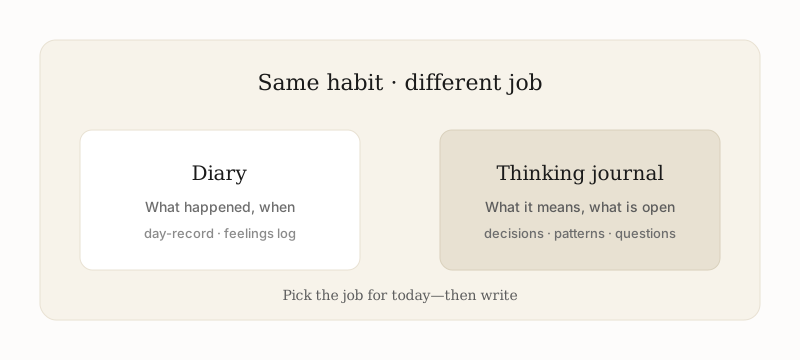
A diary records the day. A thinking journal processes decisions, patterns, and open questions. Same habit—different job.
Diary and journal get used interchangeably. Fair enough—both involve private writing on a page. But the job each one does is different.
A diary tends to record the day: what happened, how it felt, what you want to remember later. A private thinking journal tends to process something open: a decision, a loop, a pattern, a question you are still sitting with.
Same habit. Different job. Knowing which job you need—today—keeps the page useful instead of vague.
The vernacular distinction (without pedantry)
In everyday English, the words overlap. A diary often leans dated and chronological—a private day-record. A journal often leans broader—reflection, goals, ideas, or a specific practice (decision journal, travel journal, and so on). A diary is one kind of journal; not every journal is a diary.
That is the useful split for this article:
| Diary (day-record) | Thinking journal |
|---|---|
| Purpose: What happened / how it felt | Purpose: What this means / what is still open |
| Shape: Chronological life log | Shape: Topic or question as it unfolds |
| Cadence: Often daily by date | Cadence: When something needs processing |
| Review: Remembers the arc of days | Review: Finds patterns, themes, decisions |
| Closing line: "That was today" | Closing line: "One next step—or deliberately none" |
Neither is better. They answer different questions.
If you want the neighboring contrast—notes apps vs a dedicated journal space—see private journal vs notes app.
What a diary is good at
A diary is excellent when you want a faithful record:
- What happened today (or this week)
- How you felt in the moment
- Moments you might otherwise forget
- A chronological trail you can flip back through years later
The diary question is roughly: What happened, and when?
That record has real value. Pattern recognition over months often starts with "I wrote this down at the time." A diary also trains the simple discipline of showing up to the page.
It does not need to become a productivity system. Recording the day is enough.
What a thinking journal is good at
A private thinking journal is built for processing, not documenting:
- Decisions still open (options, fears, what "good enough" looks like)
- Loops that keep returning (name them; do not prosecute yourself)
- Questions you are sitting with (no forced answer)
- Friction and energy drains you have not named yet
- A short review pass that ends in one next step—or a deliberate pause
The thinking-journal question is roughly: What does this mean, and what—if anything—do I do next?
That is closer to how to keep a private decision journal than to a daily life log. Prompts help when the blank page stalls you—see seven prompts for a private thinking journal.
Privacy matters here. When there is no audience, you can stay unfinished. Messy middle drafts are the point, not a failure of polish.
Same habit, different job—pick by need
You do not have to pick one forever. Pick by what the page is for today.
Lean diary when you need to:
- Capture the day before it blurs
- Keep a dated trail for later memory
- Dump feelings without turning them into a plan
- Build a gentle daily writing rhythm
Lean thinking journal when you need to:
- Untangle a decision
- Notice a repeating theme
- Separate feeling / fact / still-open
- Leave with one quiet next step
- Review a week for signal, not nostalgia alone
Mixing both in one notebook is fine. Mixing both without noticing is what creates fog: you think you are reflecting when you are mostly recounting—or you try to force every day-record into a life lesson.
A simple check at the top of the page:
Am I recording the day, or processing something open?
Answer that first. Then write.
How review differs
Writing is valuable. Looking back is where the job shows up.
Diary review often asks: What was that season like? You skim dates, remember context, feel the arc of a month or a year.
Thinking-journal review often asks: What kept returning? What resolved? What is still open? You sample themes, search one word across entries, and close with a short meta-note. A weekly thinking digest is one calm way to do that without rereading everything.
For a fuller clarity loop—write, leave space, review, one next step—see the ultimate guide to getting clarity from a private thinking journal.
Can one notebook do both?
Yes. Many people keep a single private book and switch modes.
A few practical guardrails:
- Label the mode in the first line (
Day/Decide/Loop/Question). Future-you will thank you when reviewing. - Do not force a moral onto every diary entry. Not every day needs a lesson.
- Do not skip the closing line on thinking entries. One next step—or "not fixing this yet"—keeps review from wandering.
- Keep privacy intact. No social layer. No feed. No pressure to sound finished.
If your current book works, keep it. If day-records and decision threads keep colliding, a dedicated thinking space can reduce friction. Separation is not about multiplying tools; it is about matching the tool to the job—same idea as keeping calendar, email, and notes apart.
Soft traps on both sides
Diary traps
- Turning every entry into a performance of "how my day should look"
- Guilt when you miss a calendar day (cadence is a tool, not a verdict)
- Never looking back, so the record never becomes signal
Thinking-journal traps
- Over-frameworking (tags, streaks, elaborate systems that become the work)
- Mixing the page with a todo list until reflection disappears
- Reviewing forever without a closing line
For cadence that survives real life, see habits that stick and the checklist for a private thinking journal.
Try a space built for thinking
If your diary already serves you as a day-record, keep it. When you need a calm place for decisions, patterns, and open questions—with meaning-search and soft weekly digests, and no social—Ivory Journal is designed as a private thinking journal.
- Private by default (no sharing features, no public profile)
- Chronological entries without organizational theater
- Soft weekly digests when you want a review pass
- Meaning-search to follow one theme across dates
- Web and mobile, always in sync
Browse the blog, or start writing in Ivory Journal when a quiet thinking page sounds useful.
Related reading
- Private Journal vs Notes App
- Ultimate Guide to Getting Clarity from a Private Thinking Journal
- How to Keep a Private Decision Journal
- How to Build a Weekly Thinking Digest
- 7 Prompts for a Private Thinking Journal
- Private Thinking Journal Checklist
- 5 Private Journaling Habits That Actually Stick
- Back to all posts
- Ivory Journal home
Start your thinking practice
Try Ivory Journal—a private, distraction-free space for your thoughts.
Get started