The Ultimate Guide to Getting Clarity from a Private Thinking Journal
A practical ultimate guide to using a private thinking journal for clarity—what to write, how to review, and how to act without an audience.
Clarity isn't a mood. It's knowing what you're carrying—and what to do next.
A private thinking journal is one of the calmest ways to get there. Not because writing is magic. Because private writing removes the performance layer: no audience, no feed, no need to sound finished.
This guide is practical. What clarity means on the page. What to write when you feel foggy. A simple loop you can repeat. How weekly and monthly review sharpen the signal. How search helps you find themes without rereading everything. And the traps that turn journaling into theater again.
What "clarity" means in a private journal
Clarity is not a perfect plan. It is not a productivity dashboard. It is not a polished insight you could post.
In a private journal, clarity usually looks like one of these:
- You can name what is actually on your mind (not what you think should be).
- You can see the difference between a feeling, a fact, and a decision still open.
- You can choose one next step—or deliberately choose none for now.
- You can leave the page without the same loop spinning at full volume.
That is quieter than "life-changing breakthrough." It is also more useful day to day.
Productivity theater asks you to track, tag, streak, and optimize. Clarity writing asks you to notice, name, and act lightly. If your journal starts to feel like a second job, you have drifted toward theater.
Why privacy unlocks clearer thinking
When you write for someone else—even an imaginary reader—you tidy. You skip the ugly middle. You present conclusions before you have earned them.
Privacy changes the job. You can be messy, contradictory, and unfinished. That is where thinking actually happens.
Privacy helps because:
- You stop performing. No need to sound wise. No need to resolve every paragraph.
- You can repeat yourself. The same worry across five entries is data, not failure.
- You can be specific. Names, numbers, fears, half-formed hunches—details you would never share.
- Looking back stays honest. Review without an audience is just pattern-finding, not reputation management.
A notes app can hold private text. A thinking journal goes further: it is a place built for reflection, meaning-search, and quiet review—not for tasks, bookmarks, or a public profile. If you are weighing the difference, see private journal vs notes app.
What to write when you feel foggy
Fog rarely needs a framework. It needs capture.
Start with what is present—not what would look good later.
Present-moment capture
Ask: What is taking up space right now?
Write the loop as it is. Incomplete sentences are fine. Two minutes is enough. The goal is to get the noise out of your head and onto a page you can leave.
Decisions still open
If something needs a choice, name it plainly:
- What am I deciding?
- What am I afraid will happen either way?
- What would "good enough" look like this week?
You do not need a full decision journal every time. When you do, how to keep a private decision journal walks through a calm template.
Friction and energy drains
Fog often hides in friction: the meeting that drained you, the task you keep postponing, the conversation that still echoes.
Write the friction without fixing it yet. Naming the drain is already a form of clarity.
Questions you are sitting with
Not every entry needs an answer. Sometimes the clearest line is the question itself.
Prompts help when the blank page stalls you. We collected seven prompts for a private thinking journal—use them as doorways, not homework.
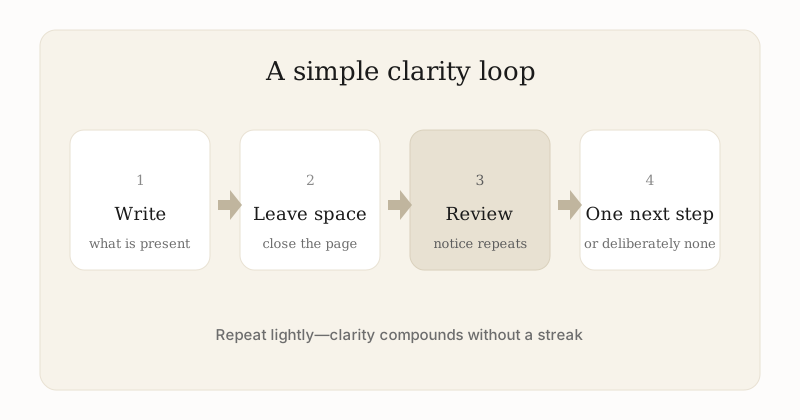
A simple clarity loop: write → leave space → review → one next step
Clarity compounds when writing and review stay light. Try this loop:
- Write — Capture what is present. Short is fine.
- Leave space — Close the journal. Let the entry sit. Do not force a conclusion in the same breath.
- Review — Later (same day, next morning, or in a weekly pass), read a small set of entries. Notice what repeated.
- One next step — Write one concrete action—or one thing you are deliberately not fixing. Then stop.
The "one next step" matters. Without it, review can feel like wandering. With it, the loop has a quiet closing line you can find later.
You will not run a perfect loop every day. That is fine. The habit is the shape, not the streak. For cadence that survives real life, see habits that stick and the Q&A on how often to journal.
Weekly and monthly review habits that create clarity
Writing captures the fog. Review turns it into signal.
Weekly
Once a week, skim the last seven days. Ten to fifteen minutes is enough. Ask:
- What kept returning?
- What resolved on its own?
- What is still open?
- What is one small adjustment for next week?
A structured pass helps: how to build a weekly thinking digest. Soft digests in a private tool can gather the week without turning review into homework.
Monthly
A full reread of every page is optional—and often too heavy. Sample instead: same-date entries, the week around a transition, the unusually long notes, or one keyword search.
We wrote a full roundup of six quiet ways to review a month of private journal entries. Pair that with a short meta-note at the end: what repeated, what shifted, one next action.
Weekly digests make monthly review lighter. Monthly sampling makes the year readable. Neither requires perfection.
Search and meaning: finding themes without rereading everything
You do not need to reread your entire archive to get clarity. You need a thread.
Pick one word or phrase for the session—tired, decide, enough, family, ship—and search only for that. Write down what repeats and what surprises you. Then close the search.
That is meaning-search in practice: following one question across dates, not cataloging your whole life.
Searchable private entries make this easier than flipping a notebook by hand—especially when the same theme shows up under different wording. Soft meaning-search in a private thinking journal is built for that kind of look-back, without a feed or followers.
If you already keep weekly digests, search plus a digest skim is often enough. You are tracing a theme, not scoring yourself.
Common traps
Perfectionism
Waiting for the right notebook, the right prompt pack, or a profound topic delays the only step that works: writing what is present. Messy first drafts are the point.
Over-frameworking
Tags, moods, streaks, and elaborate systems can become the work. If setup takes longer than the entry, simplify. Capture first. Structure later—only if it earns its keep.
Mixing with todos
When the journal becomes a task list, reflection disappears. Keep thinking separate from managing. Process on the page; put actions in whatever system already runs your day—after you name the one next step.
Reviewing without closing
Endless rereading without a short meta-note or next step can feel productive while leaving the fog intact. End reviews with one line you can find later.
Judging past you
Old entries will look silly, repetitive, or half-wrong. Observe; do not prosecute. The messy pages are often the honest ones.
Choosing a calm private tool
Your tool should remove friction, not create it.
Look for:
- Privacy by default — no social layer, no public profile, no sharing pressure.
- Easy capture — open and write from the device you actually have.
- Search and review — find themes without drowning in pages.
- Soft digests — optional weekly summaries when you want them.
- Simplicity — no setup maze before the first sentence.
If you want a calm space built for this—entries, meaning-search, weekly digests, no social—Ivory Journal is designed that way. Free to start when a quiet page sounds useful.
Browse the blog, or start writing in Ivory Journal.
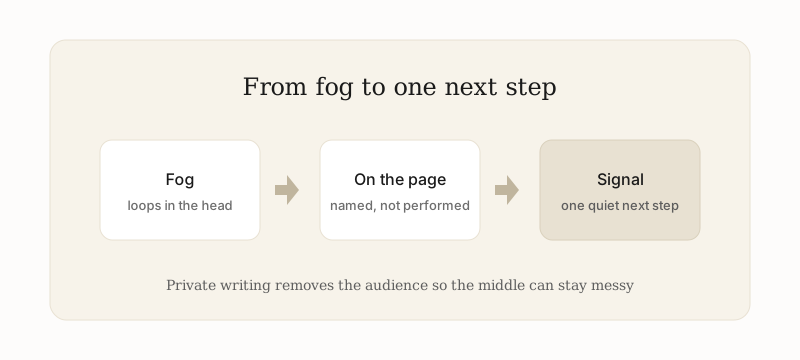
For the broader practice—what a thinking journal is, how to start, and how habits stick—see the ultimate guide to a private thinking journal. This guide zooms in on clarity: fog → page → review → one next step.
Related reading
- Ultimate Guide to a Private Thinking Journal
- How to Build a Weekly Thinking Digest
- 6 Quiet Ways to Review a Month of Private Journal Entries
- How to Keep a Private Decision Journal
- 7 Prompts for a Private Thinking Journal
- 5 Private Journaling Habits That Actually Stick
- Private Journal vs Notes App
- Q&A: How Often Should I Keep a Private Thinking Journal?
- Back to all posts
- Ivory Journal home
Start your thinking practice
Try Ivory Journal—a private, distraction-free space for your thoughts.
Get started